Gelatide Official Website › Ingredients
The Gelatide Ingredient List, Extract by Extract
Gelatide lists six botanical extracts on its label artwork.
They are green tea leaf, guarana seed, African mango seed, coleus forskohlii root, capsicum annuum fruit and raspberry ketones. Two of the six carry caffeine.
See how they fit together in how Gelatide works.
This page takes each extract in turn and gives it the same four lines: what it is, what dose the research used, what this label does not say, and what to check before you take it.
What the Gelatide artwork names
One panel, six names, and the three things a Supplement Facts panel would have carried instead.
The image beside this paragraph is the manufacturer’s own Inside Gelatide panel. It is the only ingredient document in the material supplied to this desk, and it is worth reading as much for its layout as for its content.
Six boxes, six plant photographs, six full botanical names with the plant part specified. That is more care than many listing panels take: naming the part matters, because a leaf extract and a root extract of the same plant are different products with different chemistry.
And then nothing. No milligrams, no standardisation percentage, no order of predominance. Six names in six boxes, arranged for symmetry rather than for quantity.
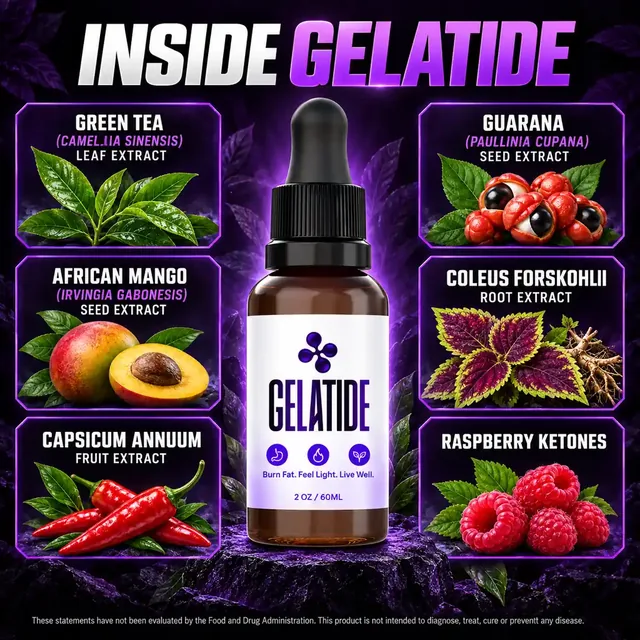
Every extract in Gelatide, in full
Green Tea Leaf Extract
Camellia sinensis, leaf · amount per serving not publishedThe catechin source, and one of the two caffeine-bearing items on this label.
What the research actually used. The best-studied item on this panel, and the findings are small. A meta-analysis of eleven studies found a mean difference of about 1.3 kg over twelve weeks, and later reviews could not separate the catechins from the caffeine that arrives with them.
What this label leaves out. Those trials used a stated catechin dose, usually several hundred milligrams of EGCG a day. This label prints no amount for green tea leaf extract, and no EGCG figure at all, so the comparison cannot be made in either direction.
What to watch for. Concentrated green tea extract, not brewed tea, is the form associated with rare liver injury. Stop and speak to a doctor if you develop unusual tiredness, abdominal pain, dark urine or yellowing of the eyes.
Sources: Hursel 2009 · Vazquez Cisneros 2017 · Hu 2018, the green tea safety review · the LiverTox record for green tea · NCCIH on green tea
Guarana Seed Extract
Paullinia cupana, seed · amount per serving not publishedA South American seed used for its caffeine, which it carries at a higher concentration than coffee bean.
What the research actually used. Guarana has held up in trials of fatigue rather than of body weight. A randomised trial in breast cancer patients found it reduced chemotherapy-related fatigue, and a 2024 cycling trial found guarana improved time-trial performance where a matched low dose of plain caffeine did not.
What this label leaves out. Guarana seed is roughly three to six per cent caffeine by weight depending on the extract and the drying process. The amount of guarana in this bottle is not published, so the caffeine it contributes cannot be worked out from the label.
What to watch for. This is the item most likely to cause a noticeable effect, and the one most likely to cause a problem. Caffeine stacks with coffee, tea, cola and pre-workout, and it interacts with several prescription medicines.
Sources: de Oliveira Campos 2011 · Penna 2024 · Pagliarussi 2006 · MedlinePlus on caffeine
African Mango Seed Extract
Irvingia gabonensis, seed · amount per serving not publishedA West African seed extract sold for appetite and metabolic markers.
What the research actually used. The headline trial used 150 mg of the IGOB131 extract twice a day for ten weeks and reported large changes in weight and blood lipids. A 2020 systematic review found the trial record small, concentrated in one research group and at meaningful risk of bias.
What this label leaves out. Ngondi used a specific standardised extract at 300 mg a day. This label names African mango seed extract with no amount and no standardisation, so there is no way to tell whether it is the same material.
What to watch for. Reported side effects in the trials were mild, mostly headache, sleep disturbance and gas. The concern here is evidence quality rather than safety.
Sources: Ngondi 2009, the IGOB131 trial · Lee 2020, the Irvingia meta-analysis · Nonsa-Ard 2022
Coleus Forskohlii Root Extract
Plectranthus barbatus, root · amount per serving not publishedThe root that forskolin is extracted from, standardised in trials to ten per cent forskolin.
What the research actually used. Two small 2005 trials are the whole human record. Godard gave 250 mg of a ten per cent forskolin extract twice daily to overweight men and reported a body composition change without a weight change. Henderson ran the same protocol in women and found nothing.
What this label leaves out. Both trials used 500 mg a day of a standardised extract. This label publishes neither the amount of coleus nor the forskolin percentage, which is the figure that decides whether any of this applies.
What to watch for. Forskolin lowers blood pressure and affects platelet aggregation. Do not take it if you are on blood pressure medication, a blood thinner or an antiplatelet drug without asking the prescriber first.
Sources: Godard 2005 · Henderson 2005
Capsicum Annuum Fruit Extract
Capsicum annuum, fruit · amount per serving not publishedRed pepper extract, the source of the capsaicinoids that make chilli hot.
What the research actually used. Capsaicinoids do raise energy expenditure, and the size is the honest part. A meta-analysis of human studies put the average at roughly 70 kcal a day, and a 2021 thermogenesis review agreed.
What this label leaves out. Seventy calories is about a slice of bread. It is real, it is measurable, and on its own it is not a weight outcome. The trials also state a capsaicinoid dose; this label does not.
What to watch for. Capsaicin is a gut irritant in some people. Heartburn, a warm chest and loose stools in the first week are the most commonly reported effects in this category.
Sources: Zsiboras 2018 · Irandoost 2021
Raspberry Ketones
4-(4-hydroxyphenyl)butan-2-one · amount per serving not publishedThe aroma compound that gives raspberries their smell, here as an isolated ingredient rather than an extract.
What the research actually used. This is the weakest item on the panel and it is worth being blunt about. There is no published randomised controlled trial of raspberry ketone on its own in humans. The animal and cell work is real, the human work is not there, and the one human study that includes it tested a multi-ingredient product alongside exercise and a diet, which cannot tell you what the ketone did.
What this label leaves out. There is no human dose to compare against, so the absence of a figure on this label costs less here than it does elsewhere. The gap is the evidence itself.
What to watch for. No specific interaction is established, largely because the human research that would find one has not been done.
Sources: Tao 2023 · Arent 2018
The Gelatide ingredient with no human evidence at all
Raspberry ketone is the aroma compound that makes a raspberry smell like a raspberry. It became a weight supplement ingredient after cell and rodent work, and a household name after a daytime television segment rather than after a trial. There is no published randomised controlled trial of raspberry ketone on its own in humans.
The nearest thing in the literature is Arent 2018, which tested a multi-ingredient product alongside a diet and an exercise programme, so it cannot tell you what the ketone contributed. Tao 2023 reviews the wider Rubus idaeus literature and reaches the same place: interesting chemistry, thin human record.
An ingredient can be famous and unstudied at the same time. Raspberry ketone is the clearest example in this category.
Gelatidebalance editorial deskTwo Gelatide extracts carry caffeine and neither is measured
| Source | Typical caffeine content | Amount in this bottle |
|---|---|---|
| Green tea leaf extract | Varies widely with the extract. Decaffeinated catechin extracts exist and this label does not say which was used | not published |
| Guarana seed extract | Several per cent by weight, higher than coffee bean. Pagliarussi 2006 measured how much the drying process changes it | not published |
| Stated total per serving | Would be one line on a panel | no such line exists |
A caffeine total is the one figure this label could publish without revealing a formula, because it is a property of the finished liquid rather than a recipe. What it means for your medicine cabinet is on the Gelatide safety page.
What is not in Gelatide
- ›No stated fillers or carriers. A liquid needs a base, usually water, glycerin or ethanol, and no other-ingredients line appears on the artwork supplied to this desk.
- ›No gelatin shell, which is a genuine advantage of the format over a softgel and the reason the vegetarian roundel on the artwork is unsurprising.
- ›No stated preservative system. Liquids need one. It is not named.
- ›No sweetener or flavour named. The taste is not something this desk can describe in advance.
- ›No mineral or vitamin content. Six botanicals, not a multivitamin.
An absence on a label is not the same as an absence from the bottle. Everything above is a gap in the published material rather than a statement that the liquid contains nothing but the six extracts. It cannot be a liquid and contain nothing else. If an allergen matters to you, read the bottle you receive before the first serving.
Gelatide ingredient questions
How many ingredients does Gelatide have?
Six are named on the listing artwork. A liquid also requires a base and usually a preservative, and no other-ingredients line appears on the material supplied to this desk.
How much green tea extract is in Gelatide?
Not published. No amount is printed for any of the six extracts, and there is no Supplement Facts panel behind the listing panel.
Is there a proprietary blend in Gelatide?
Not as such. A proprietary blend at least prints a total for the blend. This label prints no total and no individual figure, which is a step further than a blend.
Which Gelatide ingredient has the best evidence?
Green tea catechins, by a distance, and the findings there are still small. The weakest is raspberry ketones, which has no human trial of its own at all.
Does Gelatide contain a stimulant?
Yes. Guarana seed and green tea leaf both carry caffeine. The total per serving is not stated.
How this Gelatide ingredient page was written
Every ingredient name on this page was taken from the manufacturer’s own listing panel, reproduced above, rather than from a review column or a competitor’s description of the same product. Where the panel names a plant part, that part is carried here, because a leaf extract and a root extract are different materials.
Every study cited was confirmed against its PubMed record before it was written down: authors, journal, year and title as the database returns them. That check is not ceremonial. During this build one guessed identifier for a green tea liver-injury reference turned out to point at the chapter on kava, and only the lookup caught it.
Where a figure is not published, this page prints not published rather than a range, an estimate or a comparison to a similar product. There are eleven such entries on this page and every one of them is a real gap in the manufacturer’s material.

Every page, every journal post, the bottle facts and the ingredients go through review by Dr. Dyan Hes, MD before they ship. We write these pages from the printed Gelatide bottle, the manufacturer’s own listing artwork and the info page this desk is supplied from, cite public research for each of the six named extracts, and print “not published” wherever a figure is not disclosed rather than estimating it. This label publishes no amount for any extract and no serving size in millilitres, and that fact appears on every page where a dose is discussed. Where the seller’s marketing claims more than the bottle supports, we say so on the page. Corrections are made on the page itself and the review date moves forward. Write to [email protected]. Last reviewed September 2026 by Dr. Dyan Hes, MD.
Sources for the Gelatide ingredient claims
- Hursel R, Viechtbauer W, Westerterp-Plantenga MS. The effects of green tea on weight loss and weight maintenance: a meta-analysis. Int J Obes (Lond). 2009;33(9):956-61. https://pubmed.ncbi.nlm.nih.gov/19597519/
- Vázquez Cisneros LC, López-Uriarte P, López-Espinoza A, et al. Effects of green tea and its epigallocatechin (EGCG) content on body weight and fat mass in humans: a systematic review. Nutr Hosp. 2017;34(3):731-737. https://pubmed.ncbi.nlm.nih.gov/28627214/
- Hu J, Webster D, Cao J, Shao A. The safety of green tea and green tea extract consumption in adults — results of a systematic review. Regul Toxicol Pharmacol. 2018;95:412-433. https://pubmed.ncbi.nlm.nih.gov/29580974/
- LiverTox: Clinical and Research Information on Drug-Induced Liver Injury. Green Tea. Bethesda (MD): National Institute of Diabetes and Digestive and Kidney Diseases. https://www.ncbi.nlm.nih.gov/books/NBK547925/
- National Center for Complementary and Integrative Health. Green Tea. https://www.nccih.nih.gov/health/green-tea
- de Oliveira Campos MP, Riechelmann R, Martins LC, Hassan BJ, Casa FB, Del Giglio A. Guarana (Paullinia cupana) improves fatigue in breast cancer patients undergoing systemic chemotherapy. J Altern Complement Med. 2011;17(6):505-12. https://pubmed.ncbi.nlm.nih.gov/21612429/
- Penna EM, Harp A, Hack B, Talik TN, et al. Guarana (Paullinia cupana) but not low-dose caffeine improves cycling time-trial performance versus placebo. Int J Sport Nutr Exerc Metab. 2024;34(1):30-37. https://pubmed.ncbi.nlm.nih.gov/37898479/
- Pagliarussi RS, Bastos JK, Freitas LA. Fluid bed drying of guarana (Paullinia cupana HBK) extract: effect of process factors on caffeine content. AAPS PharmSciTech. 2006;7(2):E54. https://pubmed.ncbi.nlm.nih.gov/16796371/
- U.S. National Library of Medicine. Caffeine. MedlinePlus. https://medlineplus.gov/caffeine.html
- Ngondi JL, Etoundi BC, Nyangono CB, Mbofung CM, Oben JE. IGOB131, a novel seed extract of the West African plant Irvingia gabonensis, significantly reduces body weight and improves metabolic parameters in overweight humans in a randomized double-blind placebo controlled investigation. Lipids Health Dis. 2009;8:7. https://pubmed.ncbi.nlm.nih.gov/19254366/
- Lee J, Chung M, Fu Z, Choi J, Lee HJ. The effects of Irvingia gabonensis seed extract supplementation on anthropometric and cardiovascular outcomes: a systematic review and meta-analysis. J Am Coll Nutr. 2020;39(5):388-396. https://pubmed.ncbi.nlm.nih.gov/31855111/
- Nonsa-Ard R, Aneknan P, Tong-Un T, Honsawek S, Leelayuwat C, Leelayuwat N. Effects of Irvingia gabonensis extract on metabolism, antioxidants, adipocytokines, telomere length, and aerobic capacity in overweight/obese individuals. Nutrients. 2022;14(21):4646. https://pubmed.ncbi.nlm.nih.gov/36364907/
- Godard MP, Johnson BA, Richmond SR. Body composition and hormonal adaptations associated with forskolin consumption in overweight and obese men. Obes Res. 2005;13(8):1335-43. https://pubmed.ncbi.nlm.nih.gov/16129715/
- Henderson S, Magu B, Rasmussen C, Lancaster S, Kerksick C, Smith P, et al. Effects of coleus forskohlii supplementation on body composition and hematological profiles in mildly overweight women. J Int Soc Sports Nutr. 2005;2(2):54-62. https://pubmed.ncbi.nlm.nih.gov/18500958/
- Zsiborás C, Mátics R, Hegyi P, Balaskó M, et al. Capsaicin and capsiate could be appropriate agents for treatment of obesity: a meta-analysis of human studies. Crit Rev Food Sci Nutr. 2018;58(9):1419-1427. https://pubmed.ncbi.nlm.nih.gov/28001433/
- Irandoost P, Lotfi Yagin N, Namazi N, Keshtkar A, et al. The effect of capsaicinoids or capsinoids in red pepper on thermogenesis in healthy adults: a systematic review and meta-analysis. Phytother Res. 2021;35(3):1358-1377. https://pubmed.ncbi.nlm.nih.gov/33063385/
- Tao Y, Bao J, Zhu F, Pan M, et al. Ethnopharmacology of Rubus idaeus Linnaeus: a critical review on ethnobotany, processing methods, phytochemicals, pharmacology and quality control. J Ethnopharmacol. 2023;302(Pt A):115870. https://pubmed.ncbi.nlm.nih.gov/36341819/
- Arent SM, Walker AJ, Pellegrino JK, Sanders DJ, et al. The combined effects of exercise, diet, and a multi-ingredient dietary supplement on body composition and adipokine changes in overweight adults. J Am Coll Nutr. 2018;37(2):111-120. https://pubmed.ncbi.nlm.nih.gov/29111889/
More about Gelatide
Order Gelatide knowing exactly what the label does and does not say
Six named extracts, no published amounts, and a desk that prints that on every page rather than in a footnote.
From $49 a bottle · 60 days to change your mind
Order Gelatide On The Official WebsiteOne-time payment, no subscription · 60-day money-back guarantee · lot GEL-26/GE-6482 · tracking and refunds +1 (202) 604-0611