Gelatide Official Website › Blog › The serving size
How Many Drops Is A Serving When The Label Does Not Say
The Gelatide label prints a bottle volume and no serving size. Here is the arithmetic that recovers one, what each step of it rests on, and what happens to your cost per day when you get it wrong.
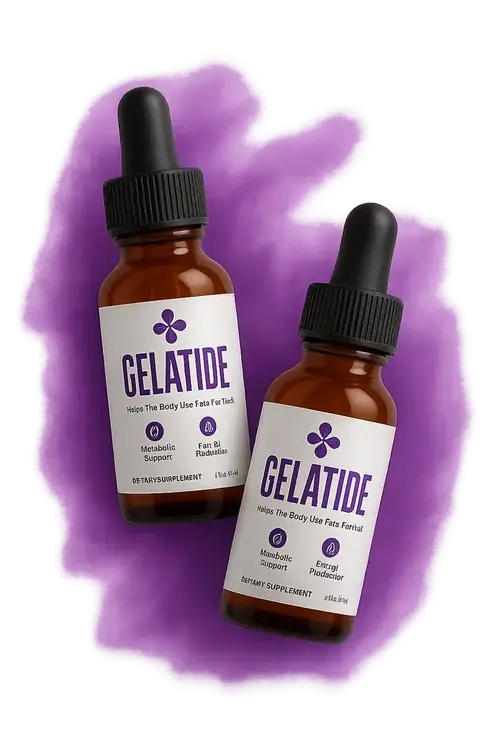
- No serving size is printed. Not in millilitres, not in drops, not anywhere on the artwork supplied to this desk.
- The arithmetic gives about 2 mL a day. 60 mL a bottle, thirty days a bottle from the seller’s own supply claim.
- That is roughly forty drops, at the usual 0.05 mL figure for a pipette drop, and drop size varies enough that forty is an order of magnitude.
- Getting it wrong costs money as well as accuracy. A third more each morning and a thirty-day bottle becomes a twenty-two-day bottle.
General information, not medical advice. Gelatide is a dietary supplement for healthy adults aged 18 and over. It is not a drug, it is not FDA-approved, and it is not intended to diagnose, treat, cure or prevent any disease. Two of its six extracts carry caffeine and the total is not published, so if you take any prescribed medicine, or are being treated for blood pressure, a heart rhythm problem, diabetes or a thyroid condition, speak to a pharmacist before adding it to anything.
The problem in one sentence
The bottle holds 60 mL. The seller sells two bottles as a sixty-day supply. And no line anywhere on the front label, the back label or the manufacturer’s listing artwork says how much of it makes one serving.
That sounds like a small omission and it is not. A serving size is the denominator for everything else: without it you cannot tell how long a bottle lasts, compare what you are taking against any published dose, or work out what the product costs you per day.
This article does the arithmetic anyway, because a page that just said “follow the label” would be handing the problem back to a reader who has already looked at the label and found nothing there. Everything derived below is labelled as derived.
The arithmetic, and what each step rests on
Three published facts, and three inferences drawn from them. The inferences are only as good as the facts underneath, so both are set out separately.
| Step | Figure | Where it comes from |
|---|---|---|
| Bottle volume | 2 fl oz / 60 mL | Printed on the front label |
| Pack supply claim | 2 bottles = 60 days | Published by the seller |
| Pack supply claim | 6 bottles = 180 days | Published by the seller |
| Days per bottle | 30 | Derived from the two rows above |
| Millilitres a day | about 2 mL | Derived: 60 divided by 30 |
| Drops a day | about 40 | Derived: 2 mL at roughly 0.05 mL a drop |
| Serving size on the label | none | There is no such line |
The two supply claims agree with each other, which is worth noting: six bottles at a hundred and eighty days is the same thirty days a bottle. A seller whose supply claims contradicted each other would tell you something different and worse.
The reassuring part of that table is the internal consistency. Both pack claims imply the same thirty days, so whoever wrote them was working from a serving size even if they never printed it. The arithmetic is recovering a number that exists somewhere rather than inventing one.
The unreassuring part is that a number which exists somewhere and is not printed is a number you cannot check. If the intended serving were 1 mL and the bottle were meant to last sixty days, both supply claims would be wrong by half and nobody reading the label could tell.
Why a drop is not a fixed quantity
The step from millilitres to drops is the softest in the chain and it deserves its own section, because “forty drops” sounds far more precise than it is.
A drop forms when surface tension can no longer hold liquid against the bore of the pipette. Its volume therefore depends on the diameter of that bore, on the surface tension and viscosity of the liquid, and on temperature, which changes both. The 0.05 mL figure, twenty drops to the millilitre, is a convention rather than a measurement of any particular product.
- A wider pipette bore makes each drop bigger, sometimes by a third.
- A glycerin-heavy base is more viscous than water and drops more slowly and more heavily.
- A cold bottle gives larger, slower drops than a warm one.
- A half-squeezed bulb gives you an underfilled pipette and a serving you never counted.
So treat forty as an order of magnitude. If you want the arithmetic to hold, the more reliable route is to count out 2 mL once with a kitchen measuring spoon, see where that reaches in the pipette, and use the pipette after that.
Why liquid labels omit this so often
A capsule label cannot avoid the question. The serving is a count, and one capsule is a complete instruction whether or not the manufacturer wanted to give one. A liquid label has to make a positive decision to print a serving, and a surprising number of products in this category decline.
There is no dark explanation required. Printing a serving size means committing to it, and committing to it means every supply claim becomes checkable. A product that prints 2 mL and thirty servings has told you that six bottles is six months and can be held to it.
It is also worth being fair about what this is not. It is not unlawful and it is not unique to this brand. It is a labelling choice that transfers a decision to the buyer, who is the person least equipped to make it.

Gelatide, with the dose question answered as far as it can be
Six named extracts in a 2 oz / 60 mL dropper bottle, and a desk that publishes the arithmetic rather than pretending the label carries a serving size.
From $49 a bottle · 60-day money-back window
Order GelatideWhat a wrong serving does to the cost per day
This is the part people miss, and it is where an unprinted serving size stops being an abstract complaint and starts costing money.
| If you take | A 60 mL bottle lasts | Six bottles last | Per day on a $294 order |
|---|---|---|---|
| 1.5 mL a day | 40 days | 240 days | $1.23 |
| 2 mL a day (the arithmetic) | 30 days | 180 days | $1.63 |
| 2.5 mL a day | 24 days | 144 days | $2.04 |
| 3 mL a day | 20 days | 120 days | $2.45 |
Two of those four rows are easy to reach by accident with a soft bulb and a busy morning. The difference between the second and the fourth is a hundred and eighty dollars a year on the same product.
Nobody sets out to take half again as much as they meant to. What happens is that the pipette looks nearly empty, the morning is rushed, and a second squeeze feels like diligence rather than error. On a capsule you would have to open a second bottle to make the same mistake.
The pricing page works the ladder out at the arithmetic serving. Every figure on it moves if your serving does, which is why that page names this assumption as the weakest number in its own table.
Measuring a dropper serving in practice
Five habits, in the order they matter. None of them is difficult and the first one is the one almost everybody skips.
- Calibrate once. Measure 2 mL into a small glass with a kitchen spoon, draw it into the pipette, and mark where it reaches. Thirty seconds, once.
- Squeeze the bulb fully. A complete compression and release fills to roughly the same point each time. A half press does not.
- Count into water rather than under the tongue. Counting is easier when you can see the drops land, and water removes the temptation to judge by feel.
- Shake before the first serving of the day. Botanical extracts settle, and the first draw from an unshaken bottle is not the same liquid as the last.
- Check the level at day fifteen. It should be about half gone. If it is two-thirds gone, you are taking more than you think.
NCCIH makes the same general point about supplements: the label is the instruction, and where it is silent, caution belongs on the low side rather than the high one. Our dosing page sets the routine out in full.
How a capsule label answers this for free
It is worth spending a paragraph on what you are giving up, because the comparison makes the omission concrete rather than theoretical.
- A capsule label prints a count. One capsule, twice daily. There is no interpretation to do.
- Servings per container follows automatically. Sixty capsules at two a day is thirty days, and the arithmetic is on the bottle rather than in an article.
- The amount per serving can be stated. Whether it is stated is a separate question, and a capsule at least has a defined serving to state it against.
- Compliance is self-checking. If capsules are left at day thirty, you missed days. A liquid gives you no such signal.
Set against that, the liquid offers one genuine advantage, which is that nobody has to swallow anything. For an adult who struggles with capsules that is not a small thing, and the format guide makes the case for it properly. It is simply not the case the marketing usually makes.
What to ask before you buy any liquid supplement
Four questions, applicable to anything sold in a dropper bottle by anybody.
- What is the serving size, in millilitres? If the label does not say, ask the seller and see whether they can. It is a fair question and the answer is informative.
- How many servings per container? Check it against the bottle volume. If the two disagree, one of them is wrong.
- Does the supply claim survive the arithmetic? A thirty-day claim on a 30 mL bottle implies 1 mL a day, which is about twenty drops. Ask yourself whether that sounds like the routine being described.
- Is there a caffeine total? On any product with guarana or green tea in it, this is the number you most need and the one most often missing. MedlinePlus explains why it matters.
The wider point behind all four is the one the FTC makes about health marketing generally: what matters is the net impression a reasonable reader takes away, not whether each individual sentence can be defended. A label that lets you infer a thirty-day supply without ever committing to one is operating in exactly that gap.
The verdict
About 2 mL a day, roughly forty drops, thirty days a bottle. That is the best available answer and it is arithmetic rather than instruction, derived from the seller’s own supply claims and published here because the alternative is a shrug.
Follow the bottle you received if it carries a serving size, because artwork changes between production runs and the printed bottle is always the authority. If it does not, calibrate the pipette once, count rather than eyeball, and check the level at day fifteen. Three minutes of effort buys you a routine you can actually describe.
And when you next compare two supplements, look for the serving line before you look at the ingredient list. It is the fastest single test of how much care went into a label, and it takes about four seconds.
Sources cited in this article
- National Center for Complementary and Integrative Health. Using Dietary Supplements Wisely. https://www.nccih.nih.gov/health/using-dietary-supplements-wisely
- U.S. National Library of Medicine. Dietary Supplements. MedlinePlus. https://medlineplus.gov/dietarysupplements.html
- U.S. National Library of Medicine. Caffeine. MedlinePlus. https://medlineplus.gov/caffeine.html
- Federal Trade Commission. Health Products Compliance Guidance. December 2022. https://www.ftc.gov/business-guidance/resources/health-products-compliance-guidance
- Maunder A, Bessell E, Lauche R, Adams J, Sainsbury A, Fuller NR. Effectiveness of herbal medicines for weight loss: a systematic review and meta-analysis of randomized controlled trials. Diabetes Obes Metab. 2020;22(6):891-903. https://pubmed.ncbi.nlm.nih.gov/31984610/

Every page, every journal post, the bottle facts and the ingredients go through review by Dr. Dyan Hes, MD before they ship. We write from the printed Gelatide bottle and the manufacturer’s own listing artwork, cite public research beside the amount that research actually used, and print “not published” wherever a figure is not disclosed rather than estimating it. This label publishes no amount for any of its six extracts and no serving size in millilitres, and that fact appears in every article that discusses a dose. Corrections are made on the page itself and the review date moves forward. Write to [email protected]. Last updated October 29, 2026.