Gelatide Official Website › Blog › The caffeine
Guarana And Green Tea: Adding Up Caffeine You Cannot See
Two of the six Gelatide extracts carry caffeine and no total is published. What each one contributes, why the number could be printed without revealing a formula, and how to manage a dose nobody will tell you.
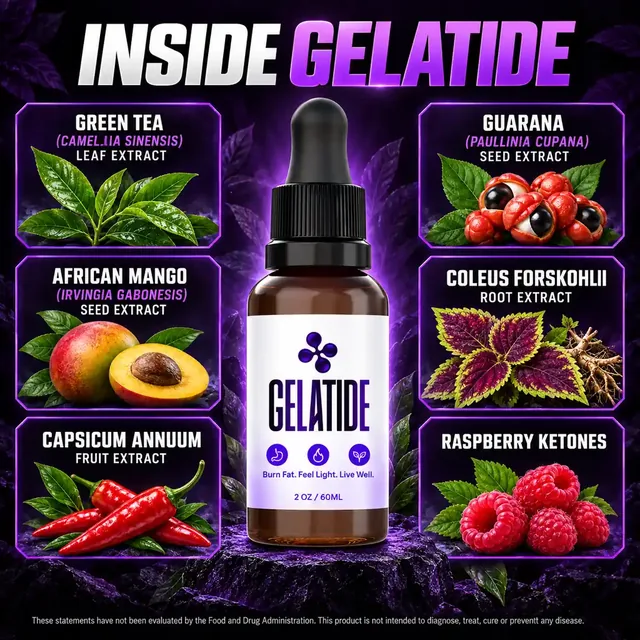
- Two of the six extracts carry caffeine, green tea leaf and guarana seed.
- Neither amount is published, and no total appears on the label, the panel or the vendor material.
- Guarana is the more concentrated source, at several per cent caffeine by weight, which is higher than coffee bean.
- You cannot budget your day around a number nobody prints. That is the practical consequence and it is the whole point of this article.
General information, not medical advice. Gelatide is a dietary supplement for healthy adults aged 18 and over. It is not a drug, it is not FDA-approved, and it is not intended to diagnose, treat, cure or prevent any disease. Two of its six extracts carry caffeine and the total is not published, so if you take any prescribed medicine, or are being treated for blood pressure, a heart rhythm problem, diabetes or a thyroid condition, speak to a pharmacist before adding it to anything.
The two caffeine sources on this panel
Read the six names on the panel above and two of them are caffeine-bearing plants. That is not hidden, it is not unusual in this category, and it is not disclosed in any form that lets you act on it.
Green tea leaf extract carries caffeine unless the extract has been decaffeinated, and the label does not say which was used. Guarana seed carries substantially more per gram than coffee bean does. Put them together in unknown quantities and you have a product that certainly contains caffeine, in an amount nobody reading the bottle can establish.
The other four are not stimulants. African mango, coleus forskohlii, capsicum annuum and raspberry ketone contribute nothing to the caffeine load, which narrows the question usefully but does not answer it.
Why guarana is the one to think about
Guarana is a Amazonian climbing plant whose seeds have been used as a stimulant for centuries, and its caffeine content is the reason it appears in this category at all.
Pagliarussi 2006 is a processing study rather than a clinical one, and it is cited here for a specific reason: it measures how much the caffeine content of a guarana extract shifts with the drying method. That is the detail behind an uncomfortable fact, which is that “guarana seed extract” on a label tells you very little about what arrives in the bottle. Two extracts of the same plant can differ substantially.
Where guarana has held up in controlled trials is fatigue and performance rather than body weight. de Oliveira Campos 2011 found it reduced chemotherapy-related fatigue in a randomised trial. Penna 2024 found guarana improved cycling time-trial performance where a matched low dose of plain caffeine did not, which is an interesting result and one that argues the plant is doing something beyond its caffeine.
None of that is a weight claim and this article is not making one. It is context for why a serious ingredient is on this panel, and why the missing amount is a real gap rather than a pedantic one.
Green tea, and the decaffeinated question
Green tea extract is the better-studied of the two and the more ambiguous. The reason is that decaffeinated catechin extracts exist and are widely used, so the presence of green tea leaf extract on a label does not by itself establish that caffeine came with it.
This label does not say. There is no “decaffeinated” qualifier, no EGCG percentage and no caffeine figure, so the honest position is that green tea here may contribute meaningfully to the total or almost nothing, and the difference is invisible.
It matters for the evidence too. Hursel 2009 pooled eleven studies of green tea and body weight and found the effect concentrated in people who were not habitual caffeine consumers, which is a strong hint that some of what the catechins were credited with was the caffeine arriving alongside them. A product that does not say which form it used cannot be placed on either side of that finding.
The total that could be printed and is not
Here is the part worth dwelling on. A caffeine total is unusually easy to publish, because it is a property of the finished liquid rather than a recipe.
| Figure | Reveals the formula? | On this label |
|---|---|---|
| Amount of each extract | Yes, largely | not published |
| Blend total | Partly, it is a ceiling | not published |
| Standardisation percentage | Partly | not published |
| Total caffeine per serving | No. It is one number about the finished product | not published |
| Serving size | No | not published |
The fourth row is the one that has no commercial excuse. A caffeine figure gives away nothing a competitor could use and answers the single most actionable question a buyer has.
Energy drinks print a caffeine figure. Coffee pods print one. Pre-workout powders, which have every commercial incentive to be vague, mostly print one, because consumers learned to ask. Botanical supplements with guarana in them frequently do not, and the reason is usually that nobody has been asked often enough.
Gelatide from a desk that prints the gap rather than the marketing
Six named extracts, two of them caffeine-bearing, and an unpublished total that this website names on every page where it matters.
From $49 a bottle · 60-day money-back window
Order GelatideWhy an unknown caffeine dose matters more than it sounds
Three consequences, in ascending order of seriousness.
- You cannot manage your day. MedlinePlus sets out where the usual adult ceiling sits. You cannot stay under a ceiling while adding an unknown quantity to a known one.
- You cannot interpret a reaction. If your heart races in week one, is that an ordinary response to a moderate dose or an unusual response to a small one? The answer changes what you should do next, and nothing on the label helps.
- You cannot answer a clinician. “How much caffeine are you having?” is a question a doctor asks for good reasons, and “some, in drops, amount unknown” is a poor answer to give about something you take every morning.
Caffeine also interacts with a longer list of medicines than most people expect, including some antidepressants, lithium, theophylline, certain antibiotics and medicines for heart rhythm. Our safety page lists them alongside the interactions from the other four extracts.
| Source | Commonly quoted amount | Stated on the label? |
|---|---|---|
| Filter coffee, one mug | around 95 mg | No, and it varies with the roast |
| Tea, one cup | around 47 mg | No |
| Cola, one can | around 34 mg | Yes, on many |
| Energy drink, one can | 80 to 300 mg | Yes, usually |
| Pre-workout, one scoop | 150 to 350 mg | Yes, almost always |
| One Gelatide serving | unknown | No |
Every row but the last can be planned around. That is the whole practical difference an unpublished figure makes, and it is why this article exists.
The week-one problem
There is a second, subtler cost to having caffeine in a blend like this, and it has nothing to do with safety.
Caffeine produces a sensation within about thirty minutes. Nothing else on this panel can. Appetite signalling and thermogenesis are weekly effects at best, and the honest timeline on our timeline page is three to six weeks. So whatever you feel on day two is the ingredient nobody is marketing, and it is arriving exactly when your expectations are highest.
That is how a stimulant blend acquires a reputation for working fast. It is also how buyers reach a favourable verdict in week one and a disappointed one in week six, which is a pattern visible in the review record of nearly every product in this category.
If you want to know whether Gelatide is doing anything beyond the caffeine, the test is week five, not week one. Everything before that is confounded by an ingredient whose amount you do not know.
Managing an unknown dose sensibly
Given that the number is not available, the sensible approach is to behave as though it were larger than you would like.
- Treat one serving as a cup of coffee you cannot see. It may be less. Planning as though it is more costs you nothing.
- Take it in the morning, never after midday, until you know how your sleep responds. Sleep is the first casualty of an unmeasured stimulant.
- Do not stack it on your largest coffee. Separate them by a couple of hours so that any reaction tells you something.
- Count your background intake for a week first. Most people underestimate it by a cup or two, and the gap is the room this product has to fit into.
- Stop if your pulse or your sleep changes. That is a signal, not a sign of it working.
NCCIH covers the general principle: botanical supplements are pharmacologically active, and treating them as inert because they are natural is the mistake the whole category encourages.
Who should not take this at all
Short list, and it is a list of exclusions rather than cautions.
- Anyone under 18, pregnant or nursing. Caffeine intake is actively managed in pregnancy and an unknown amount cannot be managed.
- Anyone who is caffeine-sensitive, or who already reaches their ceiling from coffee, tea and cola.
- Anyone taking a medicine on the caffeine interaction list, without asking the prescriber first.
- Anyone with a heart rhythm disorder, uncontrolled blood pressure or an anxiety disorder that caffeine reliably worsens.
Our suitability page has the full version, including the exclusions that come from the other four extracts rather than from the caffeine.
The verdict
Gelatide contains caffeine from two sources and does not say how much. That is the whole finding, and it is not improved by any amount of reading.
If you tolerate caffeine well, know roughly what you already have in a day, and are willing to take a morning serving and watch your sleep for a week, the gap is manageable. If you are sensitive, medicated, or simply the kind of person who likes to know what they are taking, it is a good reason to look at something that prints the number.
And it is worth asking for. A caffeine total costs the manufacturer nothing to publish and reveals nothing a competitor could use. If enough buyers ask, it appears. That is roughly how it happened in pre-workout powders, and there is no reason this corner of the shelf should be different.
Sources cited in this article
- Pagliarussi RS, Bastos JK, Freitas LA. Fluid bed drying of guarana (Paullinia cupana HBK) extract: effect of process factors on caffeine content. AAPS PharmSciTech. 2006;7(2):E54. https://pubmed.ncbi.nlm.nih.gov/16796371/
- U.S. National Library of Medicine. Caffeine. MedlinePlus. https://medlineplus.gov/caffeine.html
- Penna EM, Harp A, Hack B, Talik TN, et al. Guarana (Paullinia cupana) but not low-dose caffeine improves cycling time-trial performance versus placebo. Int J Sport Nutr Exerc Metab. 2024;34(1):30-37. https://pubmed.ncbi.nlm.nih.gov/37898479/
- de Oliveira Campos MP, Riechelmann R, Martins LC, Hassan BJ, Casa FB, Del Giglio A. Guarana (Paullinia cupana) improves fatigue in breast cancer patients undergoing systemic chemotherapy. J Altern Complement Med. 2011;17(6):505-12. https://pubmed.ncbi.nlm.nih.gov/21612429/
- Hursel R, Viechtbauer W, Westerterp-Plantenga MS. The effects of green tea on weight loss and weight maintenance: a meta-analysis. Int J Obes (Lond). 2009;33(9):956-61. https://pubmed.ncbi.nlm.nih.gov/19597519/
- National Center for Complementary and Integrative Health. Dietary and Herbal Supplements. https://www.nccih.nih.gov/health/dietary-and-herbal-supplements

Every page, every journal post, the bottle facts and the ingredients go through review by Dr. Dyan Hes, MD before they ship. We write from the printed Gelatide bottle and the manufacturer’s own listing artwork, cite public research beside the amount that research actually used, and print “not published” wherever a figure is not disclosed rather than estimating it. This label publishes no amount for any of its six extracts and no serving size in millilitres, and that fact appears in every article that discusses a dose. Corrections are made on the page itself and the review date moves forward. Write to [email protected]. Last updated October 29, 2026.